Followers

Thursday, 22 November 2012

Prominently Red;

 
 Daylily; Hemerocallis, very popular flowering plant in my garden. I have always been fascinated with these 
 easily to grow and very reliable perennials.They have made huge leaps in looks with gorgeous colours, frills, different sizes from giants to dainty minis.  They start flowering in October and keep going  for 3-4 month, depending on the plant.


Quisqualis indica also known as Rangoon Creeper. a vine with red flower clusters. It is found in Asia and in many other parts of the world. The genus translates into Latin for What is that?
For more information http://en.wikipedia.org/wiki/Quisqualis_indica


Callistemon viminalis, a red weeping bottlebrush; Do you spot the green Lorikeet enjoying the nectar of the flowers.


Dark red Hybrid Tea. Mister Lincoln

Bred by Swim & Weeks (United States, 1964). 

Dark red.  Strong fragrance.  up to 35 petals.  Average diameter 5".  Very large, full (26-40 petals), high-centered to cupped bloom form.  Blooms in flushes throughout the season.
Tall.  Matte, dark green, leathery foliage.
Height of 3' to 6' 7" (90 to 200 cm).  Width of 2' (60 cm).
Hardy.  vigorous.  heat tolerant.  In warmer climates, cut back the remaining canes by about one-third.

This rose does very well in my subtropical garden especially when it is dry.


“We can complain because rose bushes have thorns, or rejoice because thorn bushes have roses.”
Abraham Lincoln


A variegated, French bred rose; floriferous and not affected by diseases.


Hippeastrums, prominently red from October into December


I like this dwarf, red Canna lily, flowering from spring to late summer.


Hippies lighten the borders from October into December.


Curcuma is a genus of about 80 accepted species in the plant family Zingiberaceae that contains such species as turmeric and Siam Tulip. The name comes from Arabic kurkum meaning "turmeric". Since assembly of the genus Curcuma by Linnaeus in 1753 about 130 species have been described so far. Some of the species descriptions are without Latin diagnosis or type specimen, therefore the legitimate status of many species is suspicious and remains unclear.


Carl Linnaeus stating that all organisms bear relationships on all sides, their forms changing gradually from one species to the next. From Philosophia Botanica (1751).


Believe it or not:
This world, after all our science and sciences,
 is still miracle;wonderful, inscrutable, magical 
and more, to whosoever will think of it.Thomas Carlyle


Wednesday, 7 November 2012

Daylillies in the Summergarden;

Beloved deceiver;  Salter 1996; this daylily grows and flowers very well in my garden, zone 11, scape 24" flower 4.5" evergreen, Tetraploid.

Up into the cherry tree 
Who should climb but little me? 
I held the trunk with both my hands 
And looked abroad in foreign lands. 


 Miniature Hoot; Blith Australia 
A lovely salmon-pink with darker veining. Apple green throat. Lovely form, vigorous and hardy.


That I had never seen before. 
I saw the next door garden lie, 
Adorned with flowers, before my eye, 
And many pleasant places more 


Cindy's eye; Salter 1994, 30" 6" blooms semi evergreen, does grow and bloom very well.
I saw the dimpling river pass 
And be the sky's blue looking-glass; 
The dusty roads go up and down 
With people tramping in to town. 


I have received this one as a gift, can not recall its name. The flowers look stunning, semi evergreen, very tall and vigorous.

If  I could find a higher tree 
Farther and farther I should see, 
To where the grown-up river slips 
Into the sea among the ships, 


Beloved deceiver; growing in the herb garden.


To where the road on either hand 
Lead onward into fairy land, 
Where all the children dine at five, 
And all the playthings come alive. 
Robert Louis Stevenson


Ash Rosy; NUNAN - 1997 - DIP - 6" - EVERGREEN - 26" - EM - RE Australian cultivar. Blend of pink & purple, large ashes of roses watermark. Continuous blooming.


Marilyn Siwik; David Kirchhoff  1994 new in my garden.


Spacecoast passion released; (Kinnebrew,  2002) new in my garden.
6”, ev, , TET – wide and trimmed with metallic lace.  Scapes are 30”, 

Steve Trimmer;  Trimmer 1999; 5.25" blooms semievergreen, Tetraploid,  good branching on tall sturdy scapes,  good budcount and sets seed easily.


A few of my daylilies. The garden is very dry and some are much later as I do not water all of them. Or only occasionally when they are very stressed. 


Believe it or not: “There's place and means for every man alive.”
-William Shakespeare 


Thursday, 4 October 2012

The garden in October;

Red, orange, pink, white, blue and yellow;


Hippeastrums , bold and  bright, dominate the garden in October.


They are all grown from seed over some years.


One of the first; miniature daylily; Orangeade;


Tiny Mangoes are forming, hopefully it will be a good harvest.


A Pomegranate tree growing in the garden is a special treat;  for its delightful  flowers and its wonderful fruit.


By denying scientific principles, one may maintain any paradox. 
Galileo Galilei 


Exotic looking EL Capitolito Hibiscus.


Under the hood;  Spathiphyllum, elegant, floriferous plant easily to grow.


Dendrobium Aphyllum, the softest colours intriguingly patterned.


Orange coloured Hippeastrum seedling; "Peppe" one always hopes for that special one!


Tiny native bee Trigona carbonaria is busy collecting nectar and pollen, they smear wax all over their entry to keep predators away.


Mini Epiphyllum "Rosy" the first to flower in October.


Bougainvilleas grow in many colours in my garden;


A bad hairday for the pony tail plant
Beaucarnea recurvata it is now generally accepted as Nolina recurvata.


Birds of all feathers;  Exotic Strelizia


Crucifix Orchid; Epidendrum many colours  are available; flowers nearly all year round, suitable as cut flowers, easy to grow.
Link  http://en.wikipedia.org/wiki/Epidendrum


Dendrobium Aphyllum, a beautifully, soft coloured orchid; 


Nature is relentless and unchangeable, and it is indifferent as to whether its hidden reasons and actions are understandable to man or not. 
Galileo Galilei 


Yellow Kalanchoe, easily propagated from cuttings.


Believe it or not:
I think that in the discussion of natural problems we ought to begin not with the Scriptures, but with experiments, and demonstrations. 
Galileo Galilei 


©Text/Photos/ my garden; Ts


Links
Poetic Takeaway's;

Titania Everyday;

Thursday, 13 September 2012

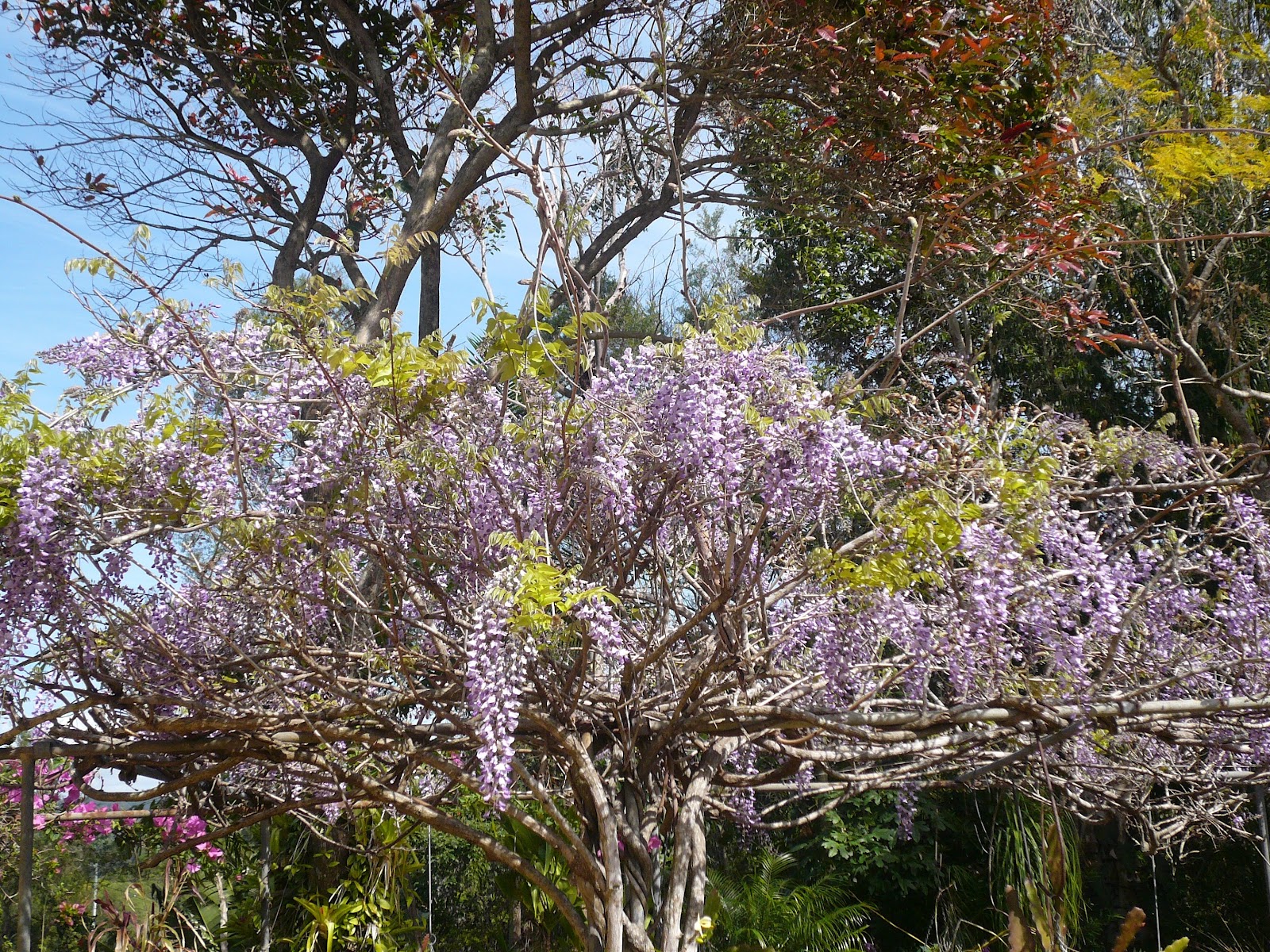
Wisteria; all in purple;


Short and sweet;


Photos from my garden 9/September 2012

Wisteria belongs to a genus of flowering plants in the pea family, Fabaceae.
 Some species are popular ornamental plants. 


Wisteria vines climb by twining their stems either clockwise or counter-clockwise round any available support. They can climb as high as 20 m above the ground and spread out 10 m laterally. 

Carpenter bees like purple coloured flowers.  You can see the metallic blue/green colour of the Peacock Carpenter bee,  Xylocopa bombylans. 

Peacock Carpenter bee; Xylocopa bombylans;  (Wikipedia)


If you have a garden and a library, you have everything you need.
Marcus Tullius Cicero


Wisteria, especially Wisteria sinensis, is very hardy and fast-growing. It can grow in fairly poor-quality soils, but prefers fertile, moist, well-drained soil. They thrive in full sun. Wisteria can be propagated via hardwood cutting, softwood cuttings, or seed. However, specimens grown from seed can take decades to bloom; for this reason, gardeners usually grow plants that have been started from rooted cuttings or grafted cultivars known to flower well.

To my delight I saw two of the giant Carpenter bees. One can see just the wings and a little of its body hanging on to a wisteria flower.


Carpenter bee Xylocopa aruana


Picture  from  http://www.whatsthatbug.com

Carpenter Bee, Xylocopa aruana, which we identified on the Insects and Spiders of Brisbane website, which indicates:  “Body length 25mm  They are very large and hairy bees, with black abdomen and yellow thorax.   Theirs wings are dark brown in colour. They are solitary, i.e., living on its     own. They feed on pollen. Females make     tunnel and lay eggs in decaying wood, including dry flower sticks of grass-trees Xanthorrhoea .”


 Another reason for failure to bloom can be excessive fertilizer (particularly nitrogen). Wisteria has nitrogen fixing capability (provided by Rhizobia bacteria in root nodules), and thus mature plants may benefit from added potassium and phosphate, but not nitrogen. 


Wisteria can grow into a mound when unsupported, but is at its best when allowed to clamber up a tree, pergola, wall, or other supporting structure. Whatever the case, the support must be very sturdy, because mature Wisteria can become immensely strong with heavy wrist-thick trunks and stems. 

These will certainly rend latticework, crush thin wooden posts, and can even strangle large trees. Wisteria allowed to grow on houses can cause damage to gutters, downspouts, and similar structures. Its pendulous racemes are best viewed from below.


Wisteria flowers develop in buds near the base of the previous year's growth, so pruning back side shoots to the basal few buds in early spring can enhance the visibility of the flowers. If it is desired to control the size of the plant, the side shoots can be shortened to between 20 and 40 cm long in mid summer, and back to 10 to 20 cm in autumn. Some excerpts from wikipedia


 I like to achieve a natural look in my garden. Sometimes the garden 
 looks scruffy, sometimes like a piece of Eden, but it never looks manicured.Titania


My neighbour asked  to borrow my lawnmower. Of course,  as  long as  it  is not taken out of my garden.


Believe it or not:

Gardens are not made by singing
 'Oh, how beautiful, and sitting in the shade;
Rudyard Kipling