Followers

Saturday, 1 June 2013

Juhu or Yay...it's June;

Winter has arrived in the garden;


Home is the best  place to be when the sun beckons to come out into the garden  to get the hands into the soil and put some seed in, which in time will become lettuce or flowers or even a whole tree. Titania


The splendidly blue Salvia  "Black Knight" is still flowering. It can be propagated from cuttings in spring and summer.


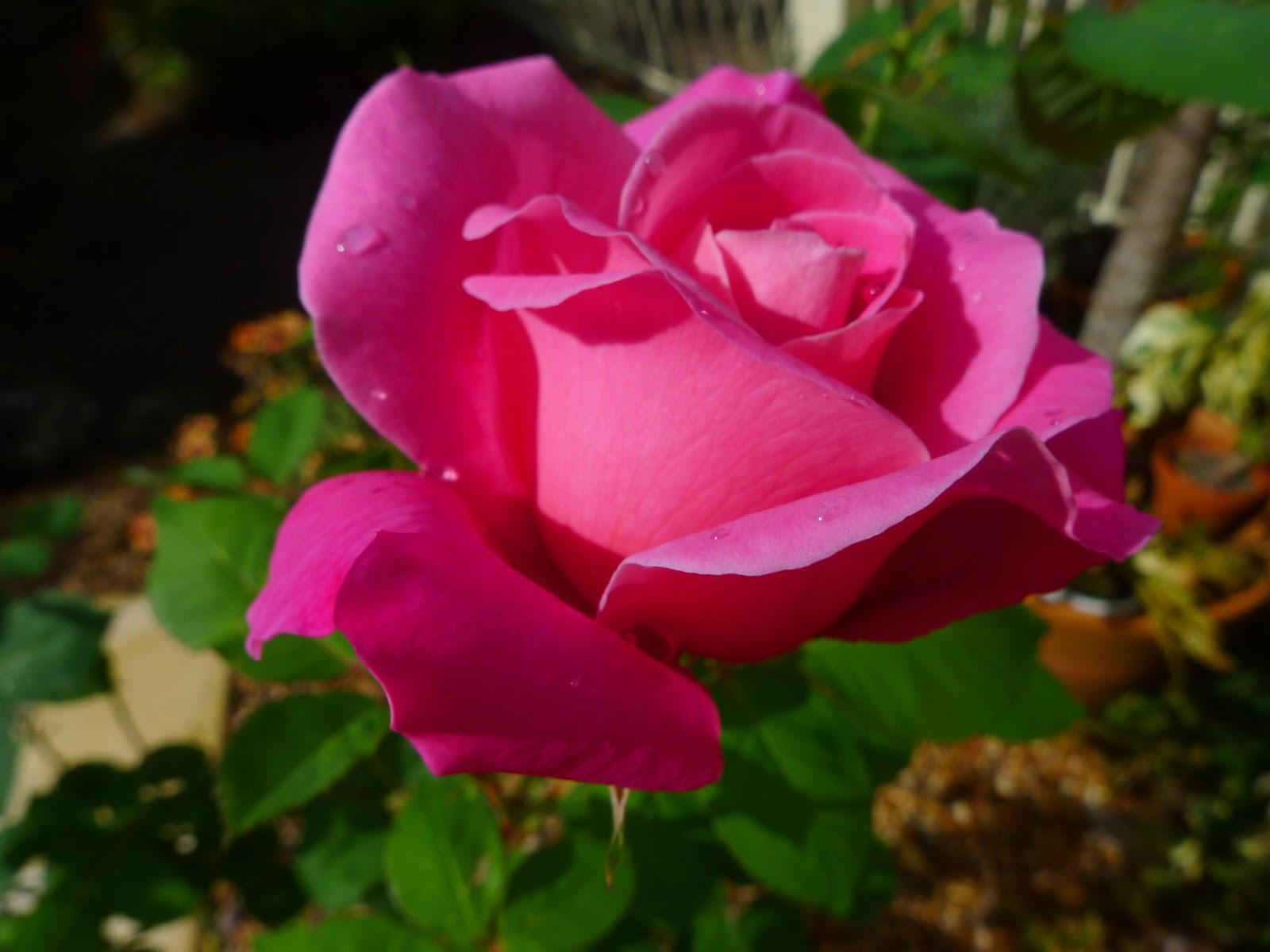
Roses take a new lease of life in winter. Perfumed Delight, has everything I expect from a rose. a wonderful warm  rose scent, strong pink, no fading colour. Beautiful shape of blooms and great to cut for inside. Now is the time to make cuttings, as cuttings from this rose grow well.
In the subtropics "Perfumed Delight is a sure winner in the cottage garden.

I named all my children after flowers. There's Lillie and Rose and my son, Artificial.
 Bert Williams 

♥

“The first supermarket supposedly appeared on the American landscape in 1946. That is not very long ago. Until then, where was all the food? Dear folks, the food was in homes, gardens, local fields, and forests. It was near kitchens, near tables, near bedsides. It was in the pantry, the cellar, the backyard.” 
Joel Salatin, Folks, This Ain't Normal: A Farmer's Advice for Happier Hens, Healthier People, and a Better World

♥


My garden provides fruit, like Bananas, Brazilian custard apple, Passion fruit, Mandarins and Pawpaws. This assortment of fruit makes fabulous desserts.


Yellow Brugmansia, delightful all year round. Now in the morning dew drops hang onto the petals and the cool makes them nearly pink, the flowers are huge,  frivolous, swaying like frilly petticoats.


Growing plants challenges and pleases the human spirit. Plants are a big part of our evolution. Many have forgotten this pleasing part of life. It is regarded as toil instead as an essential part of living. Titania


After a good pruning bougainvillea Pedro is back into flowering mood.

♥
“The greatest service which can be rendered any country is to add a useful plant to its culture.

The Fruit Hunters

♥


Delicate blush pink Camellia japonica CanCan likes to flower in the shade.


Bromeliad with hanging flowers can grow up to 1 meter long.


“A garden should make you feel you've entered privileged space -- a place not just set apart but reverberant -- and it seems to me that, to achieve this, the gardener must put some kind of twist on the existing landscape, turn its prose into something nearer poetry.” 
Second Nature: A Gardener's Education


My delightful fungi garden.


Camellias are tough as old boots;  Drama girl lives up to its reputation.


Kipfler Potatoes from the garden.


My trusty hens recycling all the scraps.  They have got a nice yard, with trees to sit in the shade,  to run or scratch for a few special treats.


Believe it or not:

Look back over the past, with its changing empires that rose and fell, and you can foresee the future, too.

 Marcus Aurelius 


©Photos from my garden/text Ts

Tuesday, 14 May 2013

MAY has entered through the back door;

Nature’s force we do not fully understand, 
 we are overwhelmed by its relentless reasons of cruelty,
 or we are awestruck by its actions of beauty and serenity. Titania


Sunrise in the Valley;


Autumn;


Allamanda cathartica is also notable for its medicinal properties: all parts of the plant contain allamandin, a toxic iridoid lactone.  Iridoids are a class of secondary metabolites found in a wide variety of plants that function as defensive compounds. 

 The leaves, roots and flowers may be used in the preparation of a powerful cathartic; the milky sap is also known to possess powerful antibacterial  properties. 

The genus name Allamanda derives from Dr. Frédéric-Louis Allamand (1735–1803), a Swiss botanist of the late 18th century.


Cat's Whiskers; Orthosiphon aristatus
Plant Type: sub-shrub
Plant Height: 1.2m
Plant Spread: 1m
Sunlight: hot overhead sun to warm low sun
Soil Moisture: dry between watering to constantly moist
Plant Uses: informal hedge, mass planting, border
Plant; Prune after flowering.


Herbgarden;

“So long as men can breathe, or eyes can see,
So long lives this, and this gives life to thee.” 
 William Shakespeare, 


Iceberg roses flower all year round in my garden.

By that sweet ornament which truth doth give.
The rose looks fair, but fairer we it deem 
For that sweet odour which doth in it live. 
W. Shakespeare


Billy, my friend and companion, in the garden he chases away the snakes!


Angel wing Begonia, slivers of sunlight make its leaves glow.


Camelia sasanqua  Plantation Pink, with its papery petals is an asset to any garden.

Camelia sasanqua has the  distinctive advantage of tolerating both full sun and partial shade. Camelia sasanqua are the most robust and versatile of all the camellia species - a finer choice for a hedge, topiary or espalier could not be made. The first of the camellia species to flower in abundance in autumn.


Camelia sasanqua. Wahroonga;


“Shall I compare thee to a summer's day?” 
 William Shakespeare,


Tree Dahlia, highlighting  the garden in autumn through winter.

The tree dahlia or Dahlia imperialis is a dramatic, fast growing perennial from South America. It grows three to five metres high with tall, sturdy bamboo-like canes topped with large lavender flowers in autumn and winter. The best time to cut them back is in winter after they have finished flowering.

* Remove all the dead wood.

* Cut down the canes that flowered last autumn; these are the ones to use for propagation.

* You can see a big bulbous bit at the bottom. That is the bulb of the dahlia that will shoot in spring and be three to five metres high again by autumn. 

* Cut canes into 50 centimetre lengths. Ensure you have at least two nodes per cane, because they’ll actually root and shoot from those nodes.

* Choose a site that’s sunny, protected from the frost and wind and dig a trench 10 centimetres deep. 

* Lay a cane horizontally along the trench. They shoot from the nodes and in no time at all, you’ll get a lovely clump.

* You could put three canes in the ground to get a nice thicket of plants.

* When new growth gets to a metre high, nip the tips out. The canes won’t get as tall but will be sturdier and more resistant to wind damage.


Sunset in the Valley;  

Believe it or not:
A man's friendships are one of the best measures of his worth.
Charles Darwin


©Photos/Text Ts

Thursday, 18 April 2013

April in my garden;


In a gardening life there are moments one never forgets.  Lupins,  in my Swiss garden, tall and straight in jewel colours, I see them like it was yesterday.Titania


Rose of Sharon; Hibiscus mutabilis; after flowering I prune it severely.

On the farm my garden started with a fig tree. It was tiny, just a cutting, Every morning, I went out and looked down from the terrace where I planted this cutting. It grew and grew, one leaf after the other. It looked so beautiful. I was waiting for the first fruit to grow. It produced wonderful  figs.  But the first growth was the best the most rewarding to watch this tiny tree spread its branches higher and higher until it reached into the terrace. When I think of this fig tree, I never see the mature tree, just the first stage as I watched it grow. Titania


I have always adored Zinnia, here I grow mainly the miniatures, usually they reseed all year round but the best time for them is spring and autumn into early winter

.Zinnia is a genus of 20 species of annual and perennial plants of the family Asteraceae. They are native to scrub and dry grassland in an area stretching from the Southwestern United States to South America, with a centre of diversity in Mexico Members of the genus are notable for their solitary long-stemmed flowers that come in a variety of bright colors.
The name honours genus German botanist Johann Gottfried Zinn (1727–59).


I have grown them for years, love how they reseed and mutate into  different  patterns and colours.


Solenostemon (coleus) is a genus of flowering plants in the family Lamiaceae, native to tropical Africa, Asia and Australia. Cultivated for their highly variegated leaves plants in this genus are still widely known as "coleus", a name which refers to a defunct genus. "Coleus" may therefore be treated as a common name.


Flowers of the giant  tropical Salvia madrensis.

Salvia madrensis is a yellow-flowered Salvia native to the Sierra Madre Oriental mountain range in Mexico, growing at 4,000-5,000 elevation in warm, wet areas. The specific epithet "madrensis" refers to the high 
mountains where it grows.

“My garden is my most beautiful masterpiece” 
Claude Monet


Pecan Nuts are ripening; this year they are small because it was a very dry spring. Normally the nuts are  much bigger, about three times this size.


Rollinia, Brazilian custard apple, is a delicious fruit to grow in the home garden. 

“The greatest fine art of the future will be the making of a comfortable living from a small piece of land.”
Abraham Lincoln


The first mandarins are ripe. they have a very thin skin and are hard  to peel, but make a sweet juice, every day.


Paperbarks, Melaleuca quinquenervia is flowering in April. Its white bottelbrush blossoms are delightful, swarrming with nectar seeking insects.
Melaleuca quinquenervia, commonly known as broad-leaved paperbark, the paper bark tea tree or niaouli, is a small- to medium-sized tree of the allspice family, Myrtaceae.


This cassia lights up the country side and the gardens. It is also known under the querky name of "Puddingpipe" tree, because its long, dark brown seed pods resemble Vanilla pods. 


The soil is littered with the big, orange flowers of the African tulip tree.
Spathodea
Spathodea is a monotypic genus in the flowering plant family Bignoniaceae. The single species it contains, Spathodea campanulata, is commonly known  here as the African Tulip tree.


The rain encourages the growth of staghorn ferns on trees and beautiful fungi in subtle colours and  patterns.


Zygopetalum is one of the Orchids flowering in April.
♥
Here I am, a small house, a large garden  and many books. Titania


Believe it or not:

“Once upon a time there were four little Rabbits, and their names were--Flopsy, Mopsy, Cottontail, and Peter. ”
― Beatrix Potter

Tuesday, 9 April 2013

Raspberry Ice;


Variegated Bougainvillea Raspberry Ice has grown a sport of whitish/ buttery leaves...


...they look very beautiful with soft pinkish tips.


The flowers look more reddish  then on the original.


the flowers of the original Raspberry Ice.


I  will make some cutting, hopefully they will grow.Bougainvillea propagation

Propagation Methods:
From herbaceous stem cuttings
From woody stem cuttings
From softwood cuttings
From semi-hardwood cuttings


It has thrown out a few large canes from the side of the original bush.

Grown in warmer climates, bougainvilleas are perennials, which means they will continue to grow and flower year after year. In Northern regions they can be grown as annuals, which means they will flourish during summer months but will not survive harsh winters.

Bougainvilleas can be cultivated as hedges, trellis-climbers or ground covers. They can also be grown as cascading potted plants or grown in hanging baskets. As climbers, they can be used to add color to decks and patios.

Bougainvillea plants are very hardy and can survive some degree of neglect, but care is required for them to truly flourish. Sunlight is essential to the healthy growth and flowering of bougainvilleas, ideally six to eight hours of sunlight per day. Less than five hours will prevent bougainvilleas from blooming. Under the right conditions, bougainvilleas  bloom for many month. In my subtropical area starting now, through winter into summer.

To keep them tidy and out of trouble, from growing to big out of bounds, they have to be pruned after flowering.


Believe it or not: 
 A man is ethical only when life, as such, is sacred to him, that of plants and animals as that of his fellow men, and when he devotes himself helpfully to all life that is in need of help.
Albert Schweizer


Monday, 1 April 2013

A short history of the rose;


Roses, Roses and more roses, the air shimmers with scent and colour. Titania


Roses have been around  a long time,  from fossil evidence found, about for 35 million years.
Today we can count 30’000 varieties. Roses have the most complicated family tree of any known flower species.


The cultivation of roses most likely began in Asia around 5000 years ago. They have been part of the human experience ever since and mentions of the flower are woven into a great many tales from the ancient world.


In Greek Mythology it was Aphrodite who gave the Rose her name. The godess of flowers chloris created the rose.
Chloris enlisted the help of Aphrodite to give the Rose beauty;
Dionyisus added nectar to give the rose a sweet scent;
The three graces gave the rose, charm, brightness and joy;
Zephyr the westwind blew away the clouds, so that
Apollo the sun god  could make the rose bloom…the creation of the Rose.


In ancient Hindu legends, Brahma, the creator of the world and Vishnu, the protector of the world had an argument whether the Lotus or the rose was more beautiful. Vishnu said the rose is more beautiful, Brahma said it was the Lotus. Brahma had never seen a rose, but when he saw one he changed his mind. As a reward he created a  beautiful bride  for Vishnu called Lakshmi. She was created from 108 large  and 1008 small rose petals.


In Crete, frescoes dating  back to 1700 BC, showing a pink rose with five petals.

Tombs in Egypt have revealed wreaths from flowers with roses among them.
In the tomb of Hawara, the wreath dates  to about AD 170 and represents the oldest preserved record of a rose species.


In the Roman empire the starving  peasants were forced to grow roses instead of food. Bath and fountains were filled with rose water and they sat on carpets of rose petals. Rose petals were used as confetti at celebrations, for medicinal purposes and  to make perfume. 


During the fifteenth century, the families fighting to control England used the rose as a symbol. The white rose represented York, and the red rose symbolized Lancaster. Not surprisingly, the conflict between these factions became known as the War of the Roses.


In the seventeenth century roses and rose water were used as legal tender, as barter in the markets, as well as payments for taxes to the royalty from the commoners.
Napoleons wife Josephine establishes a collection of  250 rose varieties at  her estate  and chateau Malmaison.
P.J. Redoute painted his famous water colour collection “Les Roses”  one of the finest botanical illustrations, in the rose garden of Malmaison.


Cultivated roses weren't introduced into Europe until the late eighteenth century. These Roses came from China and were repeat bloomers. They were of great interest to hybridizers who no longer had to wait  for their roses to bloom once a year.


Today  all roses  are divided into two groups. The old roses,  cultivated in Europe before 1800. Modern roses began to be cultivated in England and France around the turn of the
19th century.

Until the beginning of the 19th century, all roses in Europe were shades of pink or white. The red  rose came from China around 1800. 
Bright yellow roses entered the palette around 1900. 


Believe it or not: 
The rose and the thorn, and sorrow and gladness are linked together. Saadi


©Photos from my garden/ Text