it's Father's day, i'ts Children's day, its Everyday,
always flowers from the garden.
Ended the last month with roses and start this month with roses, as this, the time of roses, at least in my garden.
Ended the last month with roses and start this month with roses, as this, the time of roses, at least in my garden.

Crépuscule is a reliable rose bred by Francis Dubreuil in France in 1904. It is a Noisette, one of the Old Garden Rose categories.
In my garden practically flowering through out the year. With its decorative small clusters, Crépuscule creates a beautiful rose display with intense, sweet, Old Rose fragrance.
Crépuscule can grow into a very large tall shrub rose up to 4m high and 2 to 4m wide. It is also capable of a semi-climbing habit and can be trained against a trellis or along a fence. Crépuscule is orange, fading to apricot-yellow; the name is French for “twilight”, very apt given its colour reminiscent of sunset.
Quickly to repeat to flower, richly fragrant and very disease resistant; these attributes ensure that Crépuscule is for sure a favourite rose in my garden.

Harvested Jaboticaba. These cherry like fruit are absolutely delicious. These had the perfect ripeness and sweetness. Even the fairly tough skin could be eaten. They are like little health bombs; one fruit contains:
Jaboticaba fruit is low in carbohydrates. It is a rich source of vitamin C and also contains other vitamins like vitamin E, thiamin, niacin, riboflavin and folic acid. Minerals like calcium, potassium, magnesium, iron, phosphorus, copper, manganese and zinc are also present in this fruit. In addition to vitamins and minerals, Jaboticaba is also a good source of several amino acids, fatty acids and many powerful antioxidants that have anti-cancer and anti-inflammatory properties.
Studies reveal that Jabotica peel is a high source of dietary fiber and phenolic compounds (anthocyanins) that have potent antioxidant properties. Jabuticaba along with its Myrtaceae family fruits have high content of ellagitannins. Jaboticaba peel has one of the highest content of ellagic acid. Anthocyanins content increases with ripening of the fruit.

Also made shortbread biscuits today. Recipe from the "Great Dixter Cookbook"
As I have a habit to change recipes to suit me, I used a bit less butter and added some white wine to moisten the dough.
350 g plain flour, 175 g Rice flour, 175 g of caster sugar and I used 300g butter instead of 350 g but added 1/3 cup of white wine. Mix it all together and roll out on baking paper. Bake 180 C for around 30 min. Cut the shortbread while still hot but leave it on the tray until cool. The bikkies are delicious.

OK I think that's it for today.
I worked for about 4 hours in the herb garden, cleaning up. Not yet finished, as there is so much to do. It already looks much better again.

Many herbs find any nooks and crannies to lodge their seed. Here Mexican Tarragon has seeded into the gaps of the concrete tiles.
Love, whose month is ever May,
Spied a blossom passing fair
Playing in the wanton air.
W.Shakespeare
See you soon again.
When I wrote see you soon again I did not know that there was a terrible change on its way which my family and I did not expect to be so quick and final. Today is already the 25. of May and I was not able to continue the garden in May. Today I make myself to continue...

If nature is not broken in its core it has the great tendency to bounce back. This Dahlia was battered and crushed by rain and wind, when Cyclone Debbie was let loose. I thought it might take a year to recover if it does recover at all.. Yet in a short time it has flowered again on crooked, broken limbs. So if nature wants it we can come out of the darkest and saddest corners and flower again.Ts

The roses were just blooming and the next day I picked them for his timeless journey.

This morning one open bloom of this Geranium winked at me and smiled; red Geraniums were Peter's favourites.
RIP
Peter.
09/05/2017
Because I could not stop for Death. Emily Dickinson, 1830 - 1886
Because I could not stop for Death –
He kindly stopped for me –
The Carriage held but just Ourselves –
And Immortality.
We slowly drove – He knew no haste
And I had put away
My labour and my leisure too,
For His Civility –
We passed the School, where Children strove
At Recess – in the Ring –
We passed the Fields of Gazing Grain –
We passed the Setting Sun –
Or rather – He passed us –
The Dews drew quivering and chill –
For only Gossamer, my Gown –
My Tippet – only Tulle –
We paused before a House that seemed
A Swelling of the Ground –
The Roof was scarcely visible –
The Cornice – in the Ground –
Since then – ‘tis Centuries – and yet
Feels shorter than the Day
I first surmised the Horses’ Heads
Were toward Eternity –
Today is the last day of autumn. May went and left its mark, I will never forget. I take now every day as it comes, slowly, after my motto "tomorrow is another day". Cooler nights and mornings, brilliant sunny days...winter in the subtropics.
All the pictures were taken this morning around 11AM 31/05/2017 in my garden.

Late autumn and winter provide fresh lemons and Oranges like Washington Navel.

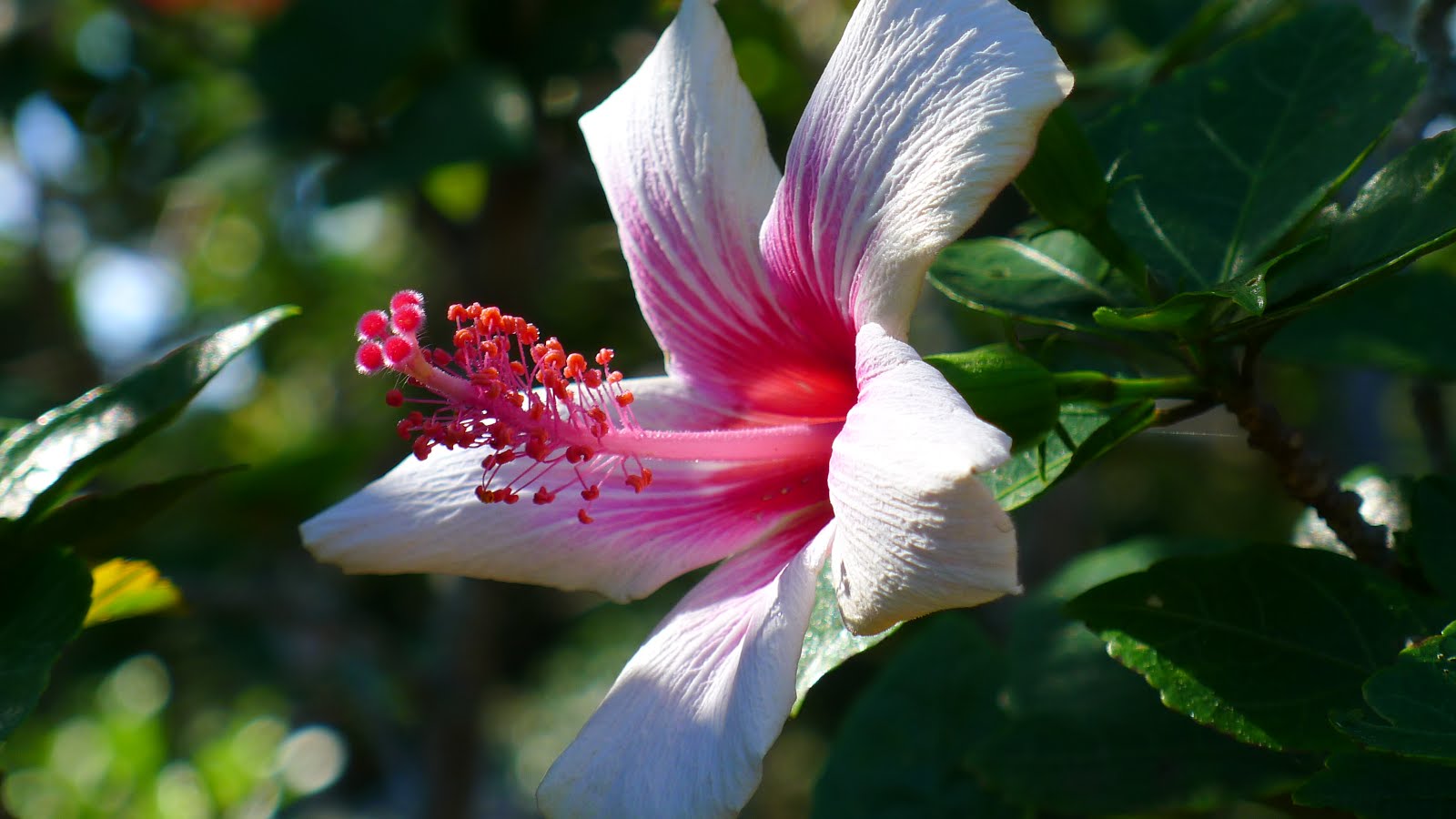
Hibiscus Fiji

One of the newer Poinsettias. This one has a subtle powder pink middle, very pretty. Received this plant from my daughter Lilli.

The lovely, tough Pentas flower through all the seasons.

A look over the fence.
Miss V's Oak leaf Poinsettia is again in full flower,
and her giant Eucalyptus tree, soaring into the sky, home of Koalas.


Pretty Poinsettia "Snowflakes";

There is still a blue banded bee enjoying the new flowers of Salvia "Majestic Towers".

Can not think of a winter in the subtropics without remembering a brilliant blue sky and pink Bougainvillea.
Tomorrow is winter;

Succulent Donkeys Ears, flowering on tall stems. Kalanchoe gastonis bonnierii.

Flowers of Flap Jack; Kalanchoe thyrsifolia.;
As Dad is not here anymore to sow and plant vegetables, which he enjoyed in his own regimental and scientific way, the girls will help with planting and harvesting. I am sure Peter would be happy to know that his vegetable garden is still in full production and very much appreciated.

In the Kitchen garden department sugar peas are growing plus many brassicas, onions, aubergines and tomatoes.

Fennel and Kohlrabi are also ready to be planted out.
Even in the subtropics, winter is a time for comfort food. Thick soups and apple pies. The days are short. It is the time for invitations to share food and stories, Ts

Red Plumbago in full regalia climbing up and mingling with long fingers into the next tree.


Pretty Vriesia catching the sun.

Finishing May with the pink roses of Monsieur Tillier. An old rose bush brilliant for the subtropical rose garden.
Next entry will be in June. Stay tuned and enjoy your life. Take care.


Pretty Vriesia catching the sun.

Finishing May with the pink roses of Monsieur Tillier. An old rose bush brilliant for the subtropical rose garden.
Next entry will be in June. Stay tuned and enjoy your life. Take care.
Poetry used by permission of the publishers and the Trustees of Amherst College from The Poems of Emily Dickinson, Ralph W. Franklin ed., Cambridge, Mass.: The Belknap Press of Harvard University Press, Copyright © 1998 by the President and Fellows of Harvard College. Copyright © 1951, 1955, 1979, by the President and Fellows of Harvard College.
Photos/Text #myGARDEN Ts


