Followers

Thursday, 13 September 2012

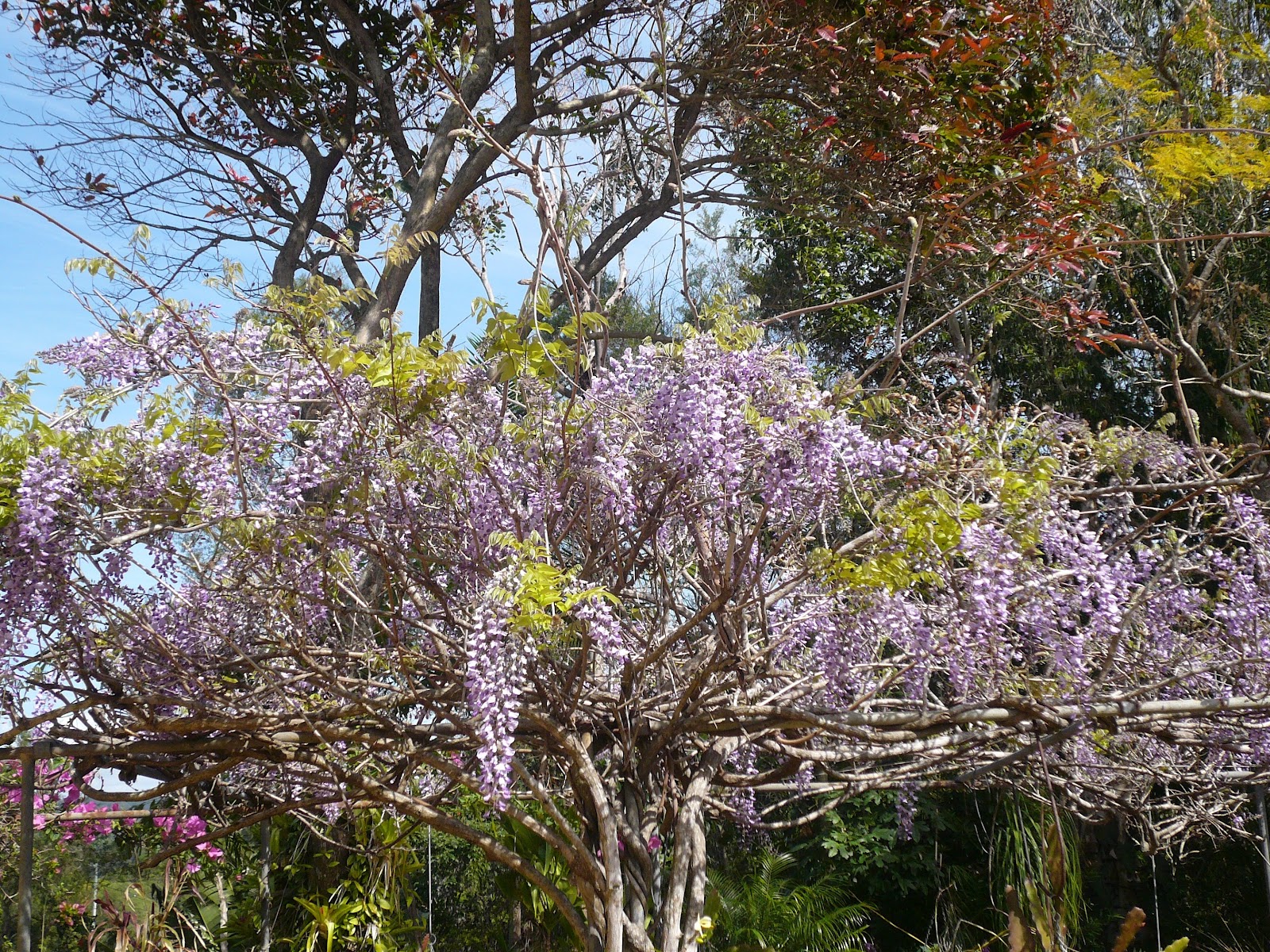
Wisteria; all in purple;


Short and sweet;


Photos from my garden 9/September 2012

Wisteria belongs to a genus of flowering plants in the pea family, Fabaceae.
 Some species are popular ornamental plants. 


Wisteria vines climb by twining their stems either clockwise or counter-clockwise round any available support. They can climb as high as 20 m above the ground and spread out 10 m laterally. 

Carpenter bees like purple coloured flowers.  You can see the metallic blue/green colour of the Peacock Carpenter bee,  Xylocopa bombylans. 

Peacock Carpenter bee; Xylocopa bombylans;  (Wikipedia)


If you have a garden and a library, you have everything you need.
Marcus Tullius Cicero


Wisteria, especially Wisteria sinensis, is very hardy and fast-growing. It can grow in fairly poor-quality soils, but prefers fertile, moist, well-drained soil. They thrive in full sun. Wisteria can be propagated via hardwood cutting, softwood cuttings, or seed. However, specimens grown from seed can take decades to bloom; for this reason, gardeners usually grow plants that have been started from rooted cuttings or grafted cultivars known to flower well.

To my delight I saw two of the giant Carpenter bees. One can see just the wings and a little of its body hanging on to a wisteria flower.


Carpenter bee Xylocopa aruana


Picture  from  http://www.whatsthatbug.com

Carpenter Bee, Xylocopa aruana, which we identified on the Insects and Spiders of Brisbane website, which indicates:  “Body length 25mm  They are very large and hairy bees, with black abdomen and yellow thorax.   Theirs wings are dark brown in colour. They are solitary, i.e., living on its     own. They feed on pollen. Females make     tunnel and lay eggs in decaying wood, including dry flower sticks of grass-trees Xanthorrhoea .”


 Another reason for failure to bloom can be excessive fertilizer (particularly nitrogen). Wisteria has nitrogen fixing capability (provided by Rhizobia bacteria in root nodules), and thus mature plants may benefit from added potassium and phosphate, but not nitrogen. 


Wisteria can grow into a mound when unsupported, but is at its best when allowed to clamber up a tree, pergola, wall, or other supporting structure. Whatever the case, the support must be very sturdy, because mature Wisteria can become immensely strong with heavy wrist-thick trunks and stems. 

These will certainly rend latticework, crush thin wooden posts, and can even strangle large trees. Wisteria allowed to grow on houses can cause damage to gutters, downspouts, and similar structures. Its pendulous racemes are best viewed from below.


Wisteria flowers develop in buds near the base of the previous year's growth, so pruning back side shoots to the basal few buds in early spring can enhance the visibility of the flowers. If it is desired to control the size of the plant, the side shoots can be shortened to between 20 and 40 cm long in mid summer, and back to 10 to 20 cm in autumn. Some excerpts from wikipedia


 I like to achieve a natural look in my garden. Sometimes the garden 
 looks scruffy, sometimes like a piece of Eden, but it never looks manicured.Titania


My neighbour asked  to borrow my lawnmower. Of course,  as  long as  it  is not taken out of my garden.


Believe it or not:

Gardens are not made by singing
 'Oh, how beautiful, and sitting in the shade;
Rudyard Kipling


♥

Friday, 24 August 2012

Delightful spring;


One touch of nature makes the whole world kin...
William Shakespeare


This is all about well loved and tried spring flowers like these charming frilly Petunias. 


My garden does not lend itself to grow annuals in garden beds, not to miss out on these lovely spring guests I plant  them in pots and troughs.


Othello: III, iii
O earth, I will befriend thee more with rain... 
W. Shakespeare

♥
♥


I grow these daisies since many years. From time to time I make new cuttings as they are so easily propagated. They will flower into summer.

♥
You are a colourful butterfly;
 flying from flower to flower;
you are here and  everywhere;
what makes you so absolutely sure?
That I am not  the one over there..... Titania
♥


So fresh, so white, harmonious...


Petunias darlings of spring;


A spring bouquet from Fabrizia;

♥

Rust coloured flowers on the Casuarina tree.


Why, what is pomp, rule, reign, but earth and dust?

King Henry VI, part III: V, ii
W. Shakespea


Crassula type succulent, growing since many years in this basket, flowering luxuriously every spring.


In spring, when geraniums are at their best they give me this Mediterranean kick like a ripe juicy fig, or a fine golden olive oil;
♥


The sweetly scented pensées, a memory of summers in Switzerland.


Pleasure and action make the hours seem short.”
-William Shakespeare


Fresh salad greens from the garden in spring;  


The pecan nut tree is still bare;


At this time of year we get lots of eggs from our black Australorp hens.


The Australorp is a chicken breed of Australian origin. It is  not a large bird, soft-feathered, with white toenails, black legs and beak, and a moderately large and upright single comb, with five distinct points.

They are very friendly, talkative hens, usually we keep between 8 to 10 hens.


Believe it or not:

You must listen to the whispers of the wind in the trees, these whispers are only for you!
Titania


♥

Link  Poetic Takeaways; a trivial world of words;

Link Titania Everyday;


Sunday, 12 August 2012

Garden fragments;


A seed  holds its  secret until  nature’s whispers wakes it up. Titania


Wisteria seed capsule;

Slow motion; Heliconia leaf;

Rouged by cold;

Lawn as white as driven snow;

Cyprus black as e'er was crow;
Gloves as sweet as damask roses.
The Winter's Tale; W.Shakespeare

Eliza's garden;

♥
Herb garden; thyme, chives, salvia and rocket;
♥

I have seen roses damask'd, red and white,
But no such roses see I in her cheeks...
W.Shakespeare Sonnet 130


Flowering  Nectarine; winter good bye;
Pretty winter asters;
♥


Flowering Mulberry tree; winter farewell;


Mulberry (Morus) is a genus of 10–16 species of trees. They are native to warm regions of Asia, Africa and the Americas, with most of the species native to Asia.
Mulberries are fast-growing when young, but soon become slow-growing and rarely grow over 10-15 meters tall. The leaves are simple, often lobed, and ridged. The fruit grows in bunches, 2-3 centimeters long, is red to dark purple in color, edible, and sweet with a good flavor in several species.
The fruit is used in pies, tarts, and wines. The fruit of the Black Mulberry, native to southwest Asia, and the Red Mulberry, native to eastern North America, have the strongest flavor. The fruit of the White Mulberry, an east Asian species, has a very weak flavor.
Mulberry leaves, particularly those of the White Mulberry, are also important as food of the silkworm, the cocoon of which is used to make silk.
Mulberries can be grown from seeds, and this is the best idea as seedling-grown trees are generally healthier. However, they are most often planted from large pieces cut from other Mulberry trees, which easily take root.


It pays to plant a very good variety with big fruit.  If you know a tree which has superior fruit take a cutting and plant it. Seed might not be reliable. The fruit from this tree grows to 5cm long and is very tasty.
Mulberries stain everything purple, including yourself. If you let your children loose on them you won’t recognize them anymore!!

The white Mulberry looks like a long white grub when ripe, yellowish,  it is honey sweet but quickly deteriorates in taste when it is too ripe.


Elkhorn ferns provide sleeping nests for ringtail possums.

Azalea Rhododendron X  Bettina;
Cleaned up the herb garden;  new pavers as well. The old ones are recycled  as pathways on the upper terrace garden.

Harvested the last blood oranges;


Could not say NO to pretty Can Can; Camellia japonica;
The rough nest of the white headed pigeon;


Believe it or not:
A therapeutic task bread making.


©Photos/Text Ts


Link   Poetic Takeaway's; a trivial world of words;

Sunday, 22 July 2012

Garden glory in July;

Oh, give us pleasure in the flowers today;
And give us not to think so far away
As the uncertain harvest; keep us here
All simply in the springing of the year.
Robert Frost

♥

Nutmeg bush; Iboza riparia;

Nutmeg bush (Tetradenia riparia or Iboza riparia).This pretty plant, with its fluffy, scented flowers, has had multiple name changes, so it is safest to stick to its common name, nutmeg bush.It should be pruned straight after its winter flowering and, is  only suitable for mostly frost-free areas.
Has nothing to do with the real nutmeg, to me it does not smell of nutmeg. 

Dreamtime;

Through winter into spring flowers this gorgeous AzaleaXRhododendron. It can grow into a  very big shrub covered in these silvery pink flowers. Easily propagated from cuttings after Christmas.

Narcissus Early Cheer;


A bunch of flowers ,Cuban Royal Palm;


It is a wholesome and necessary thing for us to turn again to the earth and in the contemplation of her beauties to know of wonder and humility.
Rachel Carson


♥


Aloes are a great winter treat. I especially like these  red bells tipped with grey-blue.


This Aloe was a gift form my neighbour. It is a prolific grower, its flowers form a crown with  a profusion of orange bells  with slightly darker tips.

♥


Peaches and Nectarines are flowering now;

Blow, Blow, Thou Winter Wind

Blow, blow, thou winter wind 
Thou art not so unkind 
As man's ingratitude; 
Thy tooth is not so keen, 
Because thou art not seen, 
Although thy breath be rude. 


Heigh-ho! sing, heigh-ho! unto the green holly: 
Most freindship if feigning, most loving mere folly: 
Then heigh-ho, the holly! 
This life is most jolly. 
William Shakespeare
♥

Kalanchoe blossfeldiana;  sunny yellow in winter;


Strawberry plants are filling out and beginning to make flowers.

We cannot command nature except by obeying her.
Francis Bacon


Fennel is a fine vegetable and grows very well through winter.


Lettuce a staple through winter;


♥
Not to forget the Kurume Azaleas and Camellias who paint the garden pink in winter.
♥


Flowering Grevillias providing nectar and pollen for birds, insects and mammals.
Spot the little Australian miner bird enjoying a sip of nectar from the flowers.


Believe it or not:
...everything in nature is lyrical in its ideal essence, tragic in its fate, and comic in its existence.
George Santayana


© Text/Photos Titania

♥