Followers

Friday, 6 May 2016

Some of my Salvias, growing and flowering in my garden, now.;


Wonderful plants, flowering for many month, easily propagated from cuttings or seed.


Pink Rosebud Salvia involucrata and Salvia Waverly.


In full flower now until spring when they will be pruned back radically.


Its sister Pink Icicle is just as pretty and attractive, also growing tall and waving its long arms around


 A Seedling discovered in Australia.


 S. Icicle together with  S. Black knight, going well together.


Salvia confertiflora,  a beautiful plant. Fairly tall growing to 1.3-2 m tall, is quite brittle. It is happy with some support from other plants to lean on. Its small iridescent orange flowers are held in velvety brownish calyxes, so very pretty. 


Salvia adenophora, here happily growing between Agapanthus.


Another tall, lanky Salvia from Mexico. I has clusters of beautiful red, somewhat  furry flowers from autumn to late spring. Its textured foliage is scented.cent. It grows to about 2 m  tall and can tolerate a part-shaded site. It also benefits from the support of other shrubs nearby.


Salvia hispanica, commonly known as chia, native to central and southern Mexico and Guatemala. 
  It is an annual and reseeds every year and  produces these pretty sky blue flowers. I let if flower where ever it is happy to do so.


Salvia Waverly produces from spring into autumn a haze of soft purple, with a little pruning in between to encourage new flowers.


Salvia leucantha


Salvia leucantha white flowers


Salvia Pink Velour


Salvia Anthony Parker


Salvia Peru blue, delightful blue flowers, heart shaped leaves and a benign creeping habit.


The very tall growing Salvia madrensis in full bloom for many month.


A well known tall  Salvia, Black Knight flowers on and on.


Here, growing  in a mixed border.


Salvia leucantha , white flowers.


Salvia Embers wishes, here growing from a cutting of the original plant.


Believe it or not:

Herb Lore
Objects containing caraway seed can not be stolen, including a husband with a few in his pocket!


©Photos #mygarden Lavender &Vanilla Ts

Wednesday, 20 April 2016

Autumn glorious autumn;


Our colourful autumn in the subtropics is not a goodbye to a  hibernation,  It is a new awakening to mellow days for plants which enjoy cool nights and sunny days. A season that inspires to work in the garden. 


Many Salvias,  like this Rosebud Salvia 
love autumn and show their best now, flowering  into winter. This one makes long canes up to 3 m, at every end develop the flowers which grow on up to 50 cm long. It is a giant under the Salvia plants.


The wonderful Salvia Waverly
 was a haze of the softest mauve all summer long and is still going.


Pink Bougainvillea  has another flush of flowers.


Salvia adenophora

a tall, willowy Salvia from Mexico. Clusters of clear red, furry flowers grace it from autumn to spring. Its attractive textured foliage has a camphor scent. It grows to about 2 m in height and can tolerate a part-shaded site. It benefits the  support of other shrubs nearby to lean on!
It may be propagated by cuttings, or by digging up a rooted piece. Prune it hard when flowering finishes.

Flowers  for a lng time in my garden, from April into Ocotber.


Camellia Setsugekka

a favoured sasanqua planted in Australia. Glossy dark green foliage and abundant large single white blooms with wavy petals.

Sasanquas love to grow in a warm full sun to partly shaded position. Prune after flowering and in Summer to maintain a compact shape. Once established sasanquas will grow in most soil types, however, they prefer a well drained slightly acidic soil. Once established they are quite drought tolerant. 


Salvia discolor

unusual dark purple, nearly black flowers. Hang them up to admire the flowers.


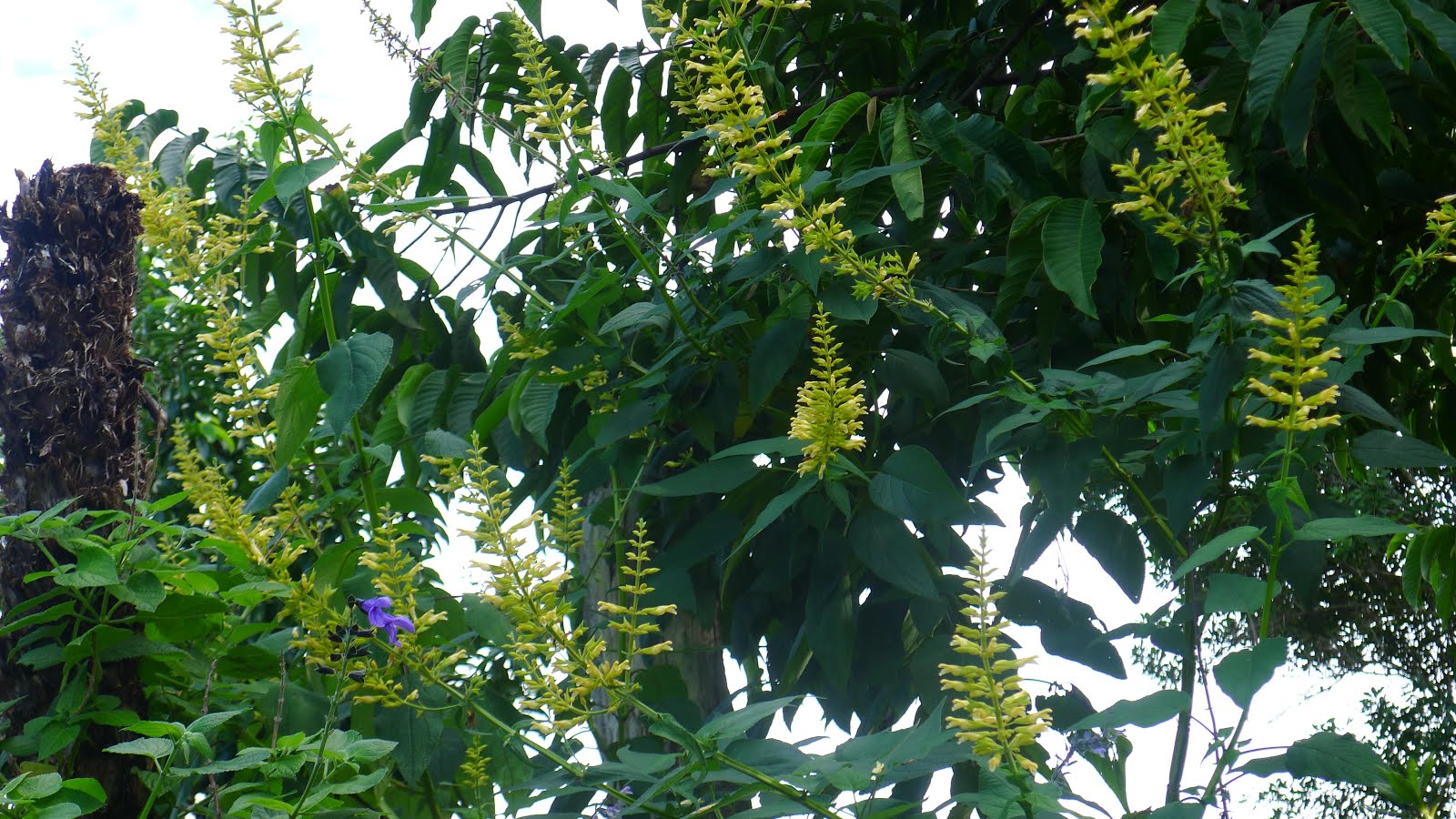
Salvia madrensis,

 tall with beautiful yellow flowers is in full swing until the time comes in late winter to prune it back.


Chia, Salvia hispanica,

 a species of flowering plant in the mint family, Lamiaceae, native to central and southern Mexico and Guatemala. It sets lots of seed and some germinate to keep the plant going in my garden. It is tall, probably around 2 m. Pretty with clear blue flowers.


  Achillea milleforium
 Yarrow, softly pink,  has found a spot to spread its feathery leaves and show of its cute flowers. It has got its name from Achilles  who has tried to cure his wounded heel with this herb, or so it is told in Mythology.
When Achilles was a baby, it was foretold that he would die young. To prevent his death, his mother Thetis took Achilles to the River Styx, which was believed to have powers of invulnerability. She  dipped his body into the water. As Thetis held Achilles by the heel, it  was not dipped into the magical water of the  river and left it vulnerable. Achilles grew up to be a man of war who survived many great battles.As foretold,  he was killed young, by a poisonous arrow that lodged in his heel, killing him shortly after.


It is getting seriously cooler when the first small flowered  gladioli  nanus show off their beauty.


Pineapple sage 
has a fruity scent, makes a great show with its red long tubes beloved by bees and other insects.


Salvia Pink Icicle
 soars to 3 m in my garden. Its flowers are a soft pink. It complements the tall ones with bright pink shades. It is an involucrata-type plant. A seedling discovered in Australia. It grows in a sunny position. Cut it back in late winter . If liked it may be  pruned back hard in early summer to control its size. Propagate from cuttings taken in spring or autumn.


Believe it or not;
Autumn is a second spring in the subtropics.


©Photos/mygarden/Text Ts Lavender&Vanilla

Wednesday, 23 March 2016

Mellow afternoon;

Today in the garden;


Brugmansia;


The sheer exuberance of flowers is amazing. Each flower is at least 30 cm long.


This tree is fairly large, standing under it, surrounded by these bells, slightly swaying, is utterly wonderful. At nightfall and early morning its fine perfume is released; a true double whammy.


Solenostemon; this one with its red splashes looks like done by an unskilled painter. Still quite attractive colours,

Solenostemon, commonly known as Coleus is a genus of flowering plants in the family Lamiaceae. Several species formerly included have been moved to the genus Plectranthus. They are native to tropical Africa, Asia and Australia. 

Here highlighted by the sun.


Roots produced by a Crucifix Orchid/Epidendrum.


Autumn is announced by the papery blossoms of a Camellia sasanqua. The first to bloom. 


Cordylines are always attractive. Especially these strap leaves in soft gelati colours.


Geraniums/Pelargoniums  have a comeback now.


Penta, attractive in many beautiful colours, a must have in subtropical gardens.


Vanda orchid, pure white flowers always a delight this time of year.


Just a  snapshot of a few flowers belonging to a huge shrub, Lycianthes rantonettii.  All summer long it is a  hub of  bees and butterflies. Generally the flowers ar e much darker, but it may sport a few white ones or in soft blue hues.


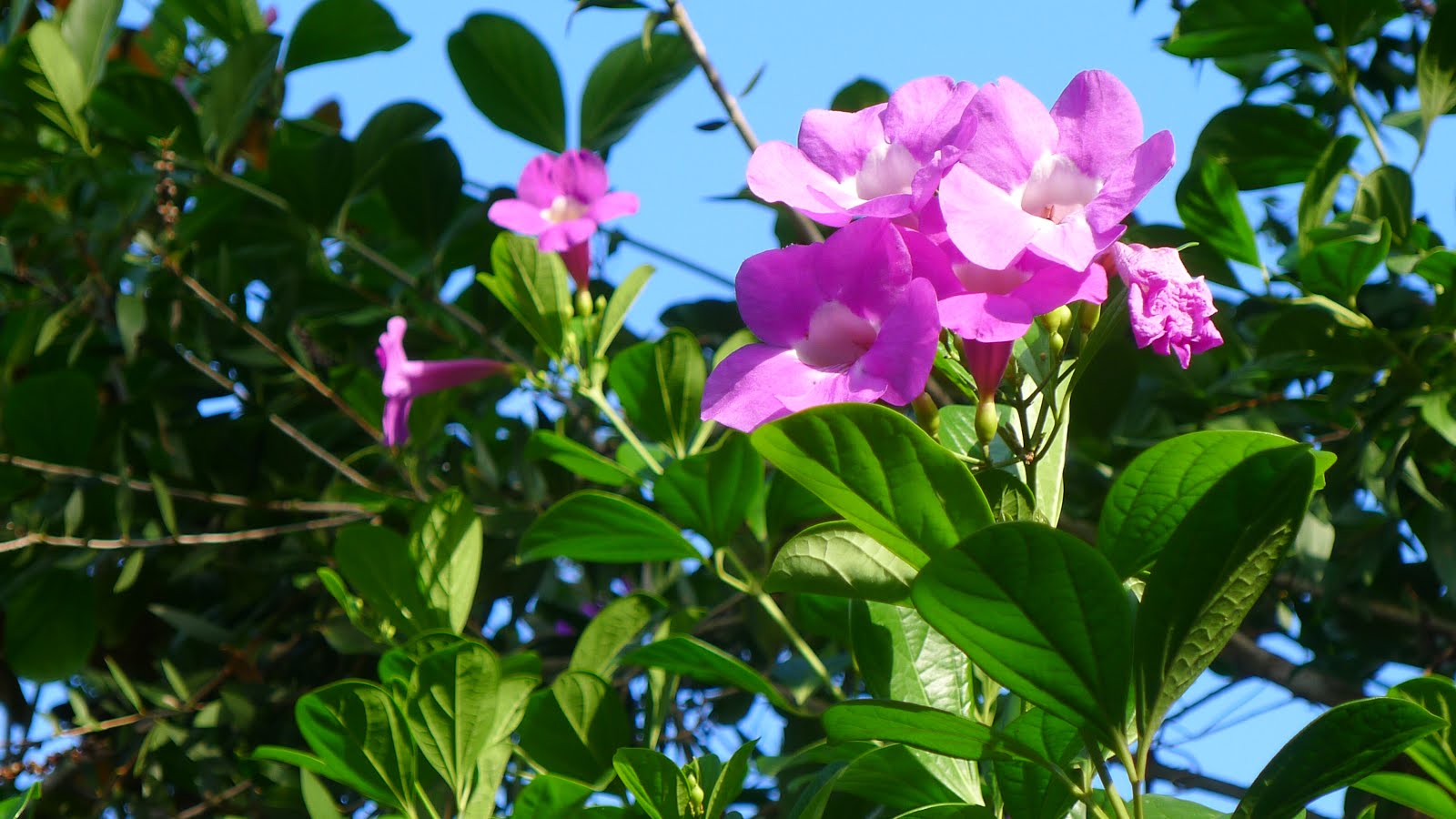
Clytostoma a strong climber may become a favourite with its lovely trumpet flowers weavin  through trees and waving them high above into the sky.


Believe it or not:

MISCHIEF shows in the leaves, but lies at the root.


©Photos/Text Ts  Lavender & Vanilla

Saturday, 12 March 2016

Purple...yellow...pink, blue and red...


...a colourful March in the subtropics.


Purple; Jules, a low growing Tibouchina. Flowers basking in the morning sun.


Purple is  the most powerful wavelength of the rainbow. It is  a powerful colour with an ancient history.
Purple dyes date back to about 1900 B.C. It needed 12,000 shellfish to extract 1.5 grams of  pure dye . Purple dye was precious and very expensive and used only for garments of the nobility.

Now we know, Purple is the most powerful visible wavelength of electromagnetic energy.  It’s just a few steps away from x-rays and gamma rays. 

Roman emperors Julius Caesar and Augustus both decreed that only the Emperor could wear purple. When Nero became Emperor, the wearing of purple and even the sale of purple was punishable by death!

Yellow  Tecoma capensis and  Easter Cassia, Senna pendula, might be an undeclared weed but it is a beautiful shrub. One is supposed to look after it and take care of the seedpods and destroy them. Driving everywhere here they light up the bush with their golden colour. I can not help myself but I love them weed or not. Native bees and other insects love the pollen and nectar they provide.


Tecoma cpensis, a softer yellow may be teamed up with any colour and it looks stunning. I have some shrubs growing together with a washed pink  and another area where it grows together with a soft mauve, both look beautiful together.


EasterCassia, Senna pendula.


Yellow, I see as a color of sunshine, happiness and optimism. It is such a joyful colour. I do not believe or agree with  its  association  of cowardice  deceit and jealousy. 

Bright yellow in combination  with black is easy to read from long distances and therefore also used for traffic signs. 

Pink, Busy Lizzy , Impatients walleriana, have been for ever in my garden. Pop up here and here for a period to bloom profusely and then disappear again. Clytostoma callistegioides, Violet trumpet vine, has climbed up with long arms on the nearby Magnolia grandiflora. High up it shows it beautiful flowers. 


Buzzy Lizzy


Clytostoma callistegioides

 Pink is a positive colour, associated with kindness. Pink inspires comfort and warm feelings.


Blue; Pickerel weed/ Pontederia cordata love to grow in ponds or bog areas. Since it has started to flower at the end of spring it is still going to the contentment for the blue banded bee visiting any time of the day. 


Blue for peace and tranquility. Blue promotes physical and mental relaxation.


Red; Bromeliads,  some have spectacular flowers, fantastic patterns  and many more great attributes.


Aechmea fulgens;


Mussaenda erythrophilla grows high up into trees . When finished flowering they will be pruned back. They are deciduous in my climate.


Philodendron "Dark Lord" freely climbing and spreading. It is a spectacular, beautiful plant for the warm climate garden.


Red is warm and positive. It is energizing and excites our emotions.


©Photos/Text Ts  Lavender & Vanilla