Followers

Thursday, 14 June 2012

Winter blues;


Sunrise in the valley;  7.June 2012
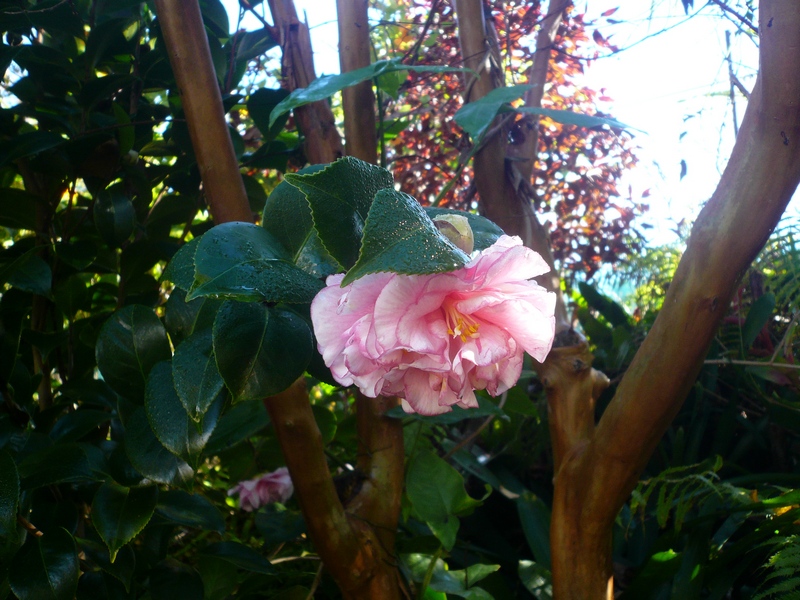


Winter, June, Camellia japonica, silky pink Can Can shows off its delicate flowers.


To forget how to dig the earth and to tend the soil is to forget ourselves.
Mahatma Gandhi


The time to harvest Mandarins and Oranges;


In winter the sun is very welcome in the kitchen nook;


Sun and shade are still playing with the huge Heliconia leaves...

We have a Little Garden

WE have a little garden,
A garden of our own, 
And every day we water there 
The seeds that we have sown.

WE love our little garden,
And tend it with such care, 
You will not find a faced leaf
Or blighted blossom there. 
Beatrix Potter


Cotoneaster's  fresh red berries are ready for the birds..


Winter is the time to look forward to harvest Rollinia or Brazilian custard apples;


...a ripe one, ready to eat...


...the white flesh is very delicious, the texture and taste similar to the Soursop, perhaps not as tangy.


We have now plenty of Navel Oranges. Every winter I make some candid Orange peel.

Easy, 1 cup water, 1 cup sugar, a few Oranges, cook slowly until the rind is soft and no syrup left.
Dry the peel on a rack and then coat with sugar; finished.

"And this our life, exempt from public haunt
Find tongues in trees, books in the running brooks,
Sermons in stones and good in everything."
William Shakespeare, As You Like It


...they flower on and on and on...

The richness I achieve comes from Nature, the source of my inspiration.
Claude Monet


The variegated leaves of the shell ginger;

Study nature, love nature, stay close to nature. It will never fail you.
Frank Lloyd Wright


The wonderful  curtain of  the weeping Casuarina;


How could one go past without admiring the beautiful trunks of the gum trees...

Man has been endowed with reason, with the power to create, so that he can add to what he's been given. But up to now he hasn't been a creator, only a destroyer. Forests keep disappearing, rivers dry up, wild life's become extinct, the climate's ruined and the land grows poorer and uglier every day.
Anton Chekhov


Want to know your bugs in the garden, this is the book...


Believe it or not:
Science is organized knowledge. Wisdom is organized life.
Immanuel Kant


Saturday, 2 June 2012

My garden in May - autumn;

As long as you live, keep learning how to live.  Seneca


Bougainvillea Pedro


I bought this one as a Bambino, but it seem to have outgrown its bambino shoes and arches up into a tree.


Generally the days are fine.


A seed hidden in an apple is an orchard invisible.


In the herb garden Thyme grows;


A broader leaved Thyme has still room to grow!


Thyme is one of the most popular culinary herbs worldwide, yet few people realize that Thymus, the botanic genus to which thyme belongs, contains 350 species, all of which are to a greater or lesser extent aromatic (though not all are useful in the kitchen).
Generally speaking, the thymes are wiry-stemmed subshrubs with small, narrowly to broadly oval leaves. Depending upon the species and cultivar, thyme leaves can be shiny, fuzzy, bright green, deep green, grey green, blue green, yellowish, silver, or variegated; furthermore, the leaves of the hardiest species can darken or redden in cold weather.
Thyme flowers, small, two-lipped, and aromatic, can come in pink, lavender, white, or crimson.


The thymes are classified by botanists as members of the Deadnettle Family (Lamiaceae or Labiatae) along with the mints, lavenders, rosemary, sage, oregano, and so many other useful herbs. Native to Southern Europe, North Africa, the Near East and the Mediterranean, many thymes are mainstays in the kitchen.!” Thymes  leaves provide us with powerful essential oils, the germicidal and antiseptic qualities of which are still valued today.


Coriander grows well in the cooler season; I let it flower and seed itself.


This variegated Bougainvillea I have planted into a huge terracotta pot, it grows in the herb garden, growing against the garage which forms a sheltering wall for the herbs.


Look at the trees, the birds, the clouds and at night go out and look at the stars!   Titania


A small fire cleans the tangled underground, ash will help ferns and other small native scrub to regrow.
In one corner old wood is accumulated as shelter for lizards, bandicoots and other small animals. At times Bush turkeys are around and collect mulch to make a mound to lay their eggs.


The beautiful Rosebud-Salvia flowers through winter;


Mint, this is Asian mint, which I like best. It grows best through the cooler season into late spring.


A handful mintleaves and  one teaspoon of organic sugar makes a fine addition to...


fresh Pineapple.


 Romeo and Juliet: Act 4, Scene 4
They call for dates and quinces in the pastry.


Sage, too is a herb which does best in the cool season.
I like to make Sage fritters as part of entrées, they usually disappear as quickly as they are made.

The vegetable garden provides sweet Kohlrabi, don't boil them to death; gently cook them  in a little butter and finely diced onion, add parsley, herbsalt, they are ready when they are nearly done, not mushy and not to hard either; delicious!
and

Beautiful sugar peas, eat  pod and all.There are still some of the Pitaya fruit ripening, these are most palatable and delicious when home grown, as they have time to ripen properly and are not harvested unripe.


A warm pink bougainvillea reaching into the blue;

Believe it or not:    When go into the garden with spade, and dig bed, feel such an exhilaration and health that discover that have been defrauding myself all this time in letting others do for me what should have done with my own hands.


©Ts


Titania's Pellucidity; PoeticTakeaway's; a trivial world of words;


Thursday, 17 May 2012

The pleasure of growing native plants;

Wake up early don't lose a day;


Callistemon, many to choose from; great gift for the birds;


Listen, and you can hear whispers in the trees...


Syzygium wilsonii subsp. wilsonii


This species is endemic to the far north Queensland rainforests, from Ingham to Cooktown, in lowland rainforests from sea level to 600-700m, growing in relatively poor soils. S. wilsonii subsp. wilsonii is suitable for a range uses and locations from Sydney to Cairns. This species can be easily incorporated into any patio, courtyard or rainforest garden.


It is a small shrub 1-3 m tall with extremely attractive flowers and foliage with clusters of edible fruit that attracts wildlife. It has weeping branches with lanceolate reddish brown new foliage. Stiff narrow leaves to 18 cm x 5 cm, dark green and dull on upper surface and paler on underneath side of leaf. This species is the only one of the lillypillies to have red flowers. They have large, fluffy heads and flower from spring to summer. White clusters of ovoid shaped fleshy fruits.


Syzygium - from Greek ‘syzygos’, joined, referring to paired leaves and branchlets of a Jamaican species.
wilsonii - derivation uncertain, possibly after Dr Thomas Braidwood Wilson (1792-1843) a botanical collector in the 1830s.


A garden you can visit anytime;


Banksia integrifolia - Coast Banksia

Genus: Banksia
Species: integrifolia
Common name: Coast Banksia, Coastal Banksia - Tree, Trees
Botanical name: Banksia integrifolia
Origin: Australia, East Coast
Height: 15.0m - 18.0m
Spread: 8.0m - 10.0m
Flower: Pale yellow Banksia flower spike, cylindrical inflorescence, hundreds of flowers packed in a spiral, 10.0cm x 5.0cm, Late Summer, Winter
Leaf: Dull dark green upper, white underside, whorls of 3 - 5, entire, 10.0cm x 3.0


Emerging flower of Banksia Robur;

Banksia robur, commonly known as Swamp Banksia grows in sand or peaty sand in coastal areas from Cooktown in north Queensland to the Illawarra region on the New South Wales south coast. It is often found in areas which are seasonally inundated.
Although it was one of the original banksias collected by Joseph Banks around Botany Bay in 1770, it was not named until 1800 by Cavanilles, with a type collection by Luis Née in 1793.

Banksia robur is a spreading shrub to 2.5 m  although can get a little larger in cultivation. It has very large, leathery tough green leaves with serrated margins up to 30 cm long and 10 cm wide. The new growth is colourful, with shades red, maroon or brown with a dense felt-like covering of brown hairs.
Plants from different areas seem to flower at different times, some spring-summer, others predominantly autumn. The stunning large flower spikes, up to 15cm high and 5-6cm wide, are metallic green with pinkish styles in bud, becoming cream-yellow and fading to golden-brown.In the golden stage. The old flowers turn grey and persist on old cones, concealing the small follicles. These follicles are reddish and furred when new, before fading. The plant is lignotuberous, regenerating from the ground after fire.


The stunning flowers of Grevillia Honey Gem;


Grevillia Honey Gem is very attractive to all birds, enjoying the nectar dripping flowers.


This is not easy to understand
For you that come from a distant land
Where all the colours are low in pitch -
Deep purples, emeralds deep and rich,
Where autumn's flaming and summer's green
Here is a beauty you have not seen.

From THE COLOURS OF LIGHT; Helen McKellar


The undemanding but beautiful, yellow flowers of Tristania neriifolia;

Tristania is a monotypic genus, native to New South Wales, Australia, closely related to Cistemon. The sole species in the genus is T. neriifolia.
It is a small tree, with dense branching. The leaves are evergreen, opposite, simple, lanceolate, from 5–9 cm long and 1 cm broad. The flowers are produced in dense clusters of 3-15 together; each flower is 1-1.5 cm diameter, with five small yellow petals and numerous conspicuous stamens.
It is commonly known as the water gum.


King Parrot;


The wonderfully fragrant Murraya;


Murraya paniculata, commonly called Orange Jessamine, is a tropical, evergreen plant bearing small, white, scented flowers, which is grown as an ornamental tree or hedge. Murraya is closely related to Citrus.

Traditionally, Murraya paniculata is used in traditional medicine as an analgesic.


Believe it or not:Think of the fierce energy concentrated in an acorn!  
You bury it in the ground, and it explodes into an oak! 
Bury a sheep, and nothing happens but decay.
-   George Bernard Shaw


©Ts


Sunday, 6 May 2012

Euphorbia milii; Sonoma;


Some are grown in pots, but they do just as well outside in the garden soil.


I like the big blooms of this Sonoma hybrid.


This creamy one has been in this pot for more then 20 years.


Live in the sunshine...swim in the sea...drink the wild air...Emerson


This one was my first  called Sonoma, a long time sitting in this pot. Lichen have been attracted to its prickly stems. I have made many cuttings which  no freely grow and flower somewhere in the garden.


Words have wings, so speak good things.


Pretty pink Euphorbia lophogona with broad leathery leaves, seeds freely but is not invasive.


When you fish for love bait with your heart.  Mark Twain


Euphorbia milii catalogue;


Titania's Pellucidity; Book of Hours;


Believe it or not:

Courage is going from failure to failure without losing enthusiasm.


©Ts